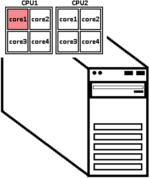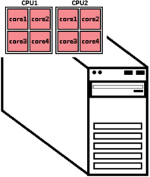
Several multithread versions of QW-Simulator are referred to by a joint notion of QW-MultiSim or its QW-MT acronym. There are four versions of QW-MultiSim:
QW-Multisim
© 2012 QWED Company. All rights reserved.    2012  |  Home  |  Events  |  Products  |  Applications  |  EU Projects  |  About  |  Support  |  Log In
QW-MTG: a two-thread version separating the actual FDTD calculations from graphics, Windows event loop, etc. The two threads are not synchronised. QW-MTG is particularly recommended to the users who need to watch dynamic field distribution, as is typically the case in microwave power applications. On the two (or more) processor computer, one processor will then take care of the display, while the other one will continue FDTD calculations at a constant speed. The FDTD speed-up factor may even reach orders of magnitude.
QW-MTN: an N-thread version for full S-matrix calculations of the N-port circuit with Smn postprocessing. The number of threads is automatically set to the number of ports. The N threads perform in parallel the analysis with excitation applied to the respective N ports. The speed-up factor will be nearly N if N processors are available in the system, and otherwise it will be limited by the number of processors.
QW-OMP (new in 6.5 QW-MultiSim version) - this version uses OpenMP programming standard (http://www.openmp.org) to accelerate the FDTD loop. Because of high parallel efficiency and no changes in the project required in comparison to standard version, the QW-OMP can become the main QW-MultiSim version. QWED recommends using this version as a very convenient, easy and efficient tool for speeding up FDTD calculations.
QW-MTGOMP: combines the advantages of QW-MTG and QW-OMP approaches. QWED recommends using this version as a very convenient, easy and efficient tool for speeding up FDTD calculations
QWED is launching an evaluation version of QW-AccelSim - hardware accelerated version of QW-Simulator running on Acceleware hardware card. QW-AccelSim has been found to provide speed-ups by approximately a factor of 16 (for dielectric resonator example with 20 Mcells). Click here to read about QW-AccelSim.
QuickWave 3D accelerated versions comparision
*Computer configuration: 2x Dual Core AMD Opteron 2GHz, 4GB RAM, WinXp Professional x64
SOFTWARE FOR ELECTROMAGNETIC DESIGN
enjoy the simulation